
 This is where opportunities for reinforcement learning algorithms are.
Think about supply chain planning and the quest to develop control towers that autonomously take care of day-to-day decision-making. That goal can never be attained without leveraging reinforcement learning or enhanced or modified versions. Outside supply chains, reinforcement learning algorithms are already being leveraged in areas involving important actions, like trading. There is nothing futuristic about using reinforcement learning in several areas of the supply chain. What is needed is creativity.
This article will focus on one specific area- sustainability analytics.
Sustainability automation and analytics is a rapidly growing areas. We have seen many sustainability-related solutions companies proliferate recently. Then there are various sustainability management and control automation platforms. Many of these automation platforms are powered by AI algorithms. Some claim to have learning capabilities, and I suspect reinforcement learning may be at play if a learning aspect is involved.
But the role reinforcement learning can play beyond how it is being
leveraged right now if it is being leveraged at all in sustainability
management platforms.
Consider an intelligent building. AI-enabled solutions allow organizations to track energy efficiency and flag anomalies (in some cases, the algorithm can generate work order requests to look into the issue). But what about the algorithm taking control and taking actions (like the sensor-actuator scenario in intelligent manufacturing)?
Smart thermostats in our homes can learn and adjust
the temperature based on our daily schedule. Intelligent buildings have a ton of many different types of sensors. With the help of these sensors and additional edge devices (smart camera, counters), a reinforcement learning algorithm can take over all aspects of managing a smart building- monitoring, reporting, and control.
The temperature in a specific room can be regulated based on occupancy figures. Cooling equipment can change operating parameters based on air parameters like humidity. Lighting can be managed based on the traffic of people in the building. The list can go on, but the gist is- there is an opportunity to use reinforcement algorithms in sustainability technology. And that opportunity is enormous.
This is where opportunities for reinforcement learning algorithms are.
Think about supply chain planning and the quest to develop control towers that autonomously take care of day-to-day decision-making. That goal can never be attained without leveraging reinforcement learning or enhanced or modified versions. Outside supply chains, reinforcement learning algorithms are already being leveraged in areas involving important actions, like trading. There is nothing futuristic about using reinforcement learning in several areas of the supply chain. What is needed is creativity.
This article will focus on one specific area- sustainability analytics.
Sustainability automation and analytics is a rapidly growing areas. We have seen many sustainability-related solutions companies proliferate recently. Then there are various sustainability management and control automation platforms. Many of these automation platforms are powered by AI algorithms. Some claim to have learning capabilities, and I suspect reinforcement learning may be at play if a learning aspect is involved.
But the role reinforcement learning can play beyond how it is being
leveraged right now if it is being leveraged at all in sustainability
management platforms.
Consider an intelligent building. AI-enabled solutions allow organizations to track energy efficiency and flag anomalies (in some cases, the algorithm can generate work order requests to look into the issue). But what about the algorithm taking control and taking actions (like the sensor-actuator scenario in intelligent manufacturing)?
Smart thermostats in our homes can learn and adjust
the temperature based on our daily schedule. Intelligent buildings have a ton of many different types of sensors. With the help of these sensors and additional edge devices (smart camera, counters), a reinforcement learning algorithm can take over all aspects of managing a smart building- monitoring, reporting, and control.
The temperature in a specific room can be regulated based on occupancy figures. Cooling equipment can change operating parameters based on air parameters like humidity. Lighting can be managed based on the traffic of people in the building. The list can go on, but the gist is- there is an opportunity to use reinforcement algorithms in sustainability technology. And that opportunity is enormous.
Reinforcement Learning for Sustainability Analytics

Amidst all the hype around AI, most organizations are still stuck with
vanilla predictive analytics models and chatbots as far as applied AI in the industry goes.
While there is no doubt that the role of AI in providing answers to critical
business decisions is significant, a huge opportunity lies in another vital area- taking action.
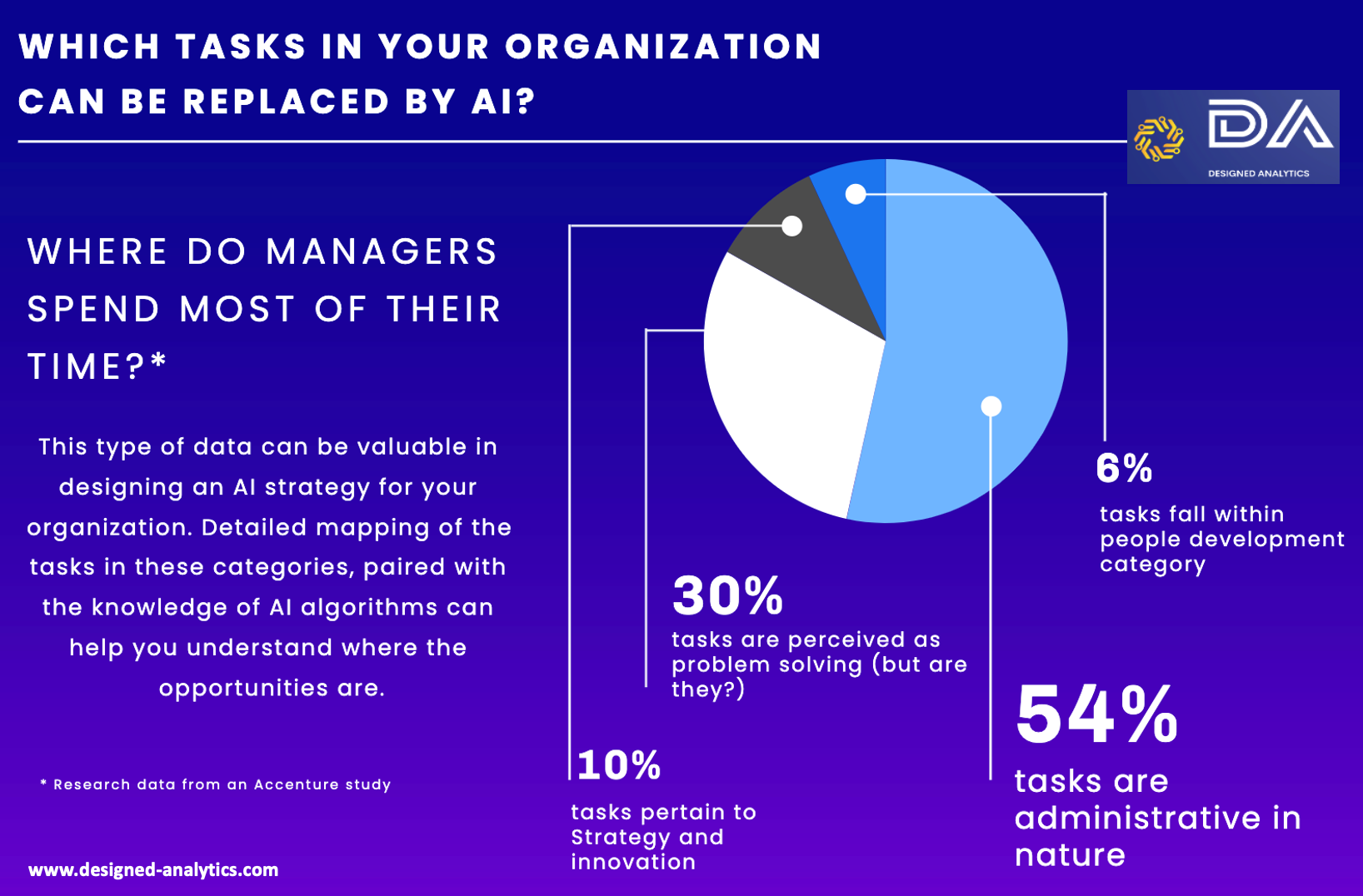
A survey by Accenture, of 1770 mid-level managers and senior executives, across 14 countries highlighted that managers believe that the majority of their task is administrative, but 30% of their role is about problem-solving. If we focus on the problem-solving category, it will be easy to categorize further the type of problem-solving into various difficulty levels.
This is where opportunities for reinforcement learning algorithms are.
Think about supply chain planning and the quest to develop control towers that autonomously take care of day-to-day decision-making. That goal can never be attained without leveraging reinforcement learning or enhanced or modified versions. Outside supply chains, reinforcement learning algorithms are already being leveraged in areas involving important actions, like trading. There is nothing futuristic about using reinforcement learning in several areas of the supply chain. What is needed is creativity.
This article will focus on one specific area- sustainability analytics.
Sustainability automation and analytics is a rapidly growing areas. We have seen many sustainability-related solutions companies proliferate recently. Then there are various sustainability management and control automation platforms. Many of these automation platforms are powered by AI algorithms. Some claim to have learning capabilities, and I suspect reinforcement learning may be at play if a learning aspect is involved.
But the role reinforcement learning can play beyond how it is being
leveraged right now if it is being leveraged at all in sustainability
management platforms.
Consider an intelligent building. AI-enabled solutions allow organizations to track energy efficiency and flag anomalies (in some cases, the algorithm can generate work order requests to look into the issue). But what about the algorithm taking control and taking actions (like the sensor-actuator scenario in intelligent manufacturing)?
Smart thermostats in our homes can learn and adjust
the temperature based on our daily schedule. Intelligent buildings have a ton of many different types of sensors. With the help of these sensors and additional edge devices (smart camera, counters), a reinforcement learning algorithm can take over all aspects of managing a smart building- monitoring, reporting, and control.
The temperature in a specific room can be regulated based on occupancy figures. Cooling equipment can change operating parameters based on air parameters like humidity. Lighting can be managed based on the traffic of people in the building. The list can go on, but the gist is- there is an opportunity to use reinforcement algorithms in sustainability technology. And that opportunity is enormous.
This is where opportunities for reinforcement learning algorithms are.
Think about supply chain planning and the quest to develop control towers that autonomously take care of day-to-day decision-making. That goal can never be attained without leveraging reinforcement learning or enhanced or modified versions. Outside supply chains, reinforcement learning algorithms are already being leveraged in areas involving important actions, like trading. There is nothing futuristic about using reinforcement learning in several areas of the supply chain. What is needed is creativity.
This article will focus on one specific area- sustainability analytics.
Sustainability automation and analytics is a rapidly growing areas. We have seen many sustainability-related solutions companies proliferate recently. Then there are various sustainability management and control automation platforms. Many of these automation platforms are powered by AI algorithms. Some claim to have learning capabilities, and I suspect reinforcement learning may be at play if a learning aspect is involved.
But the role reinforcement learning can play beyond how it is being
leveraged right now if it is being leveraged at all in sustainability
management platforms.
Consider an intelligent building. AI-enabled solutions allow organizations to track energy efficiency and flag anomalies (in some cases, the algorithm can generate work order requests to look into the issue). But what about the algorithm taking control and taking actions (like the sensor-actuator scenario in intelligent manufacturing)?
Smart thermostats in our homes can learn and adjust
the temperature based on our daily schedule. Intelligent buildings have a ton of many different types of sensors. With the help of these sensors and additional edge devices (smart camera, counters), a reinforcement learning algorithm can take over all aspects of managing a smart building- monitoring, reporting, and control.
The temperature in a specific room can be regulated based on occupancy figures. Cooling equipment can change operating parameters based on air parameters like humidity. Lighting can be managed based on the traffic of people in the building. The list can go on, but the gist is- there is an opportunity to use reinforcement algorithms in sustainability technology. And that opportunity is enormous.

 Designed Analytics Blog