

The “Groundhog Day” Fallacy of Analytics Initiatives
”Groundhog Day” is a Hollywood movie in which the central character, Phil Connors, becomes trapped in a time-loop that forces him to relive Feb 2nd repeatedly. Something similar is happening in the way we are trying to leverage analytics in the industry.
Companies across industries have been trying to solve the same problems for decades. Many of them now have large analytics teams focused on solving these problems. The issue is, these problems have not changed much in decades. At this point, organizations should have mastered and automated the analytics behind addressing these problems and moved on to solving more pressing challenges. But that is not happening, and the blame is often put on analytics talent crisis. But the fact is, there is no crisis of people with analytical intelligence, who can do analytics.
Not an Analytical Intelligence Skills Shortage
Analytics has been stereotyped into a specific type of work that needs a set of skillset we commonly refer to as analytical skills. There is no scarcity of people with analytical skills. The shortage is of the blend of skills that is now actually required to bring the analytics work stuck in the 1990s in most organizations to where it should be in the 2020s.
The challenge with leveraging intelligence type in the silo is, in my opinion, the key reason that the majority of organizations never go beyond the vanilla traditional models. This is why “typical” case studies and modeling assignments like predicting prices, churn detection, assortment optimization, etc. are abundant in the data science world.
These problem types were defined decades ago, and in 2023, labeling many of these models as “advanced” analytics should be criminal. We know exactly what type of algorithms need to be leveraged, and algorithms to address these problems are everywhere. Technological and advanced computing power allows us to solve more complex problems in these areas, but the underlying business problems are well-known and well-defined. Unless you are one of the vendors who make money solving the same problems, using the same approach, again, and again, and again, you need to move on to solve more pressing challenges. But how?
Sternberg’s Theory to the Rescue
And this is where Stenberg’s Intelligence theory comes into play. Sternberg’s triarchic theory of intelligence postulated that “general intelligence” constitutes three types of intelligence, encompassing the following three areas:
- Practical
- Distinct
- Analytical
Based on these three areas, Sternberg identified three critical types of intelligence that, when combined, help create a skillset that can address challenges that organizations face and can help develop solutions organizations need. The three core types of intelligence are depicted in the illustration below are:
- Analytical intelligence
- Creative intelligence
- Practical intelligence
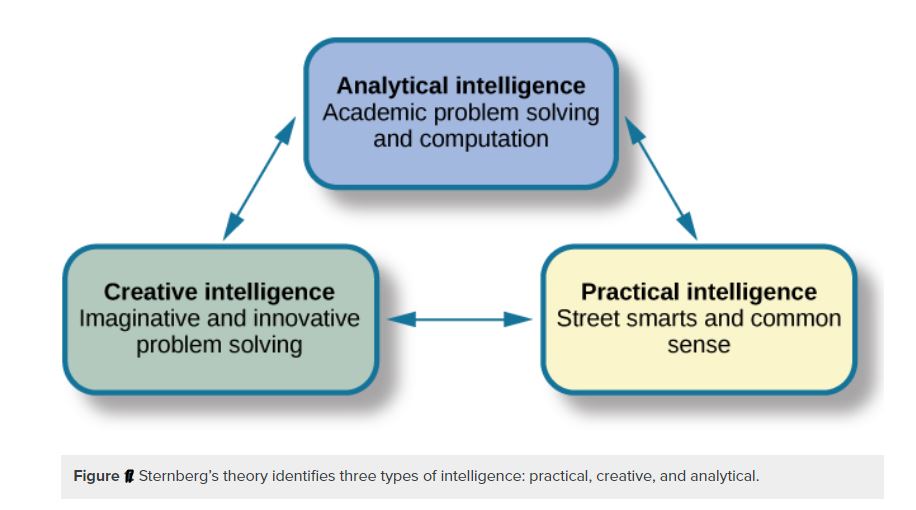
Analytical intelligence, as indicated above in the illustration, is the intelligence that allows us to do analytical problem-solving and computation.
Creative intelligence is the ability to leverage existing knowledge to create new and innovative ways to address primarily new problems and cope with new scenarios.
Practical intelligence is the ability to successfully interface and interact with the everyday world.
Example of The Value of Blended Approach
Consider the problem of SKU rationalization that companies, particularly CPG companies with large SKU portfolio run into. The analytical approaches used for SKU rationalization have remained the same while the dynamics under which businesses operate have evolved exponentially.
There is a need to think beyond existing methods. But our siloed analytical intelligence skillset is constrained by the learned knowledge of how these problems have been typically solved. While this creates a hindrance when it comes to developing real-world solution, the fact is that you do need analytical intelligence. But in tandem with other intelligence types, as defined in Sternberg’s theory.
What if we could develop new approaches to solving the SKU rationalization problem? As an example, normative finance theories can help you develop models for SKU rationalization that align more closely with the real-world challenges. Of all functions, finance was the first one to adopt advanced analytics. Financial engineering existed before any of the fancy terms we see thrown around these days.
So in this example, let us explore at a high level, how you can design a model for SKU rationalization using the normative finance theory of expected utility. Broadly, we will see how the three types of intelligence defined above are critical to developing such new approaches.
Analytical intelligence: You can not solve what you do not understand. In order to define a new way to solve a problem, you need to understand the underlying issues defining the problem. If we use the stale example of churn detection- it does not matter if you are a champion of classification models. Where you need to leverage your analytical skills is to understand what are the drivers behind the churn. Analytical intelligence helps us get that understanding.
Creative intelligence is where you start erasing the constraints to explore new approaches. If your analytical skills help you understand the fundamentals of the objectives of SKU rationalization and the fundamentals of applied expected utility theory models in finance, your creative intelligence should be able to build the bridge between these two. Creativity in this scenario will be “repurposing” a traditional normative finance model for SKU rationalization.
Practical intelligence helps you in two areas. One is when you are working on implementing analytics models. The other area, applicable to this topic, is to understand the real-world nuances of solutions. This intelligence helps support the creative intelligence aspect. When you are trying to understand how you can re-purpose a traditionally finance model for non-finance purposes, practical intelligence plays a key role.
This was a high level illustration. If you are wondering if the model developed in this example is actually feasible, the answer is yes. And leveraging a model structured around the expected utility model, for SKU rationalization, will deliver guaranteed better results, as compared to traditional approaches.
Conclusion
A quote attributed to Alon Halevy explains why our approach of considering analytics as hard science, leveraging only analytical intelligence, is flawed:
“Sciences that involve human beings rather than elementary particles have proven more resistant to elegant mathematics.”
It is time to start looking at these problems from a different perspective. Or build a team labeled “center of excellence” which solves decades old problems using decades old approaches.

 Designed Analytics Blog